
SEACEN Policy Brief Issue #3
Our new SEACEN policy brief examines how ASEAN can govern artificial intelligence (AI) to support innovation while protecting trust, accountability, and financial stability. The brief discusses that ASEAN has built a credible soft-law foundation through the ASEAN Guide on AI Governance and Ethics and the Expanded ASEAN Guide for Generative AI. These frameworks align broadly…
SEACEN Policy Brief Issue #2
The SEACEN Centre announces the release of Practices in Management of Interest Rate Risk in the Banking Book (IRRBB). The paper examines risk management practices and disclosure levels among selected major Global Systemically Important Banks (G-SIBs) and Domestic Systemically Important Banks (D-SIBs). It highlights practices that support more robust assessment of banks’ IRRBB management and…
SEACEN Policy Brief Issue #1

This SEACEN Policy Brief explores how rapid structural change driven by digitalisation and AI adoption, as illustrated by the spread of generative AI such as ChatGPT, challenges fundamental economic relationships and the management of monetary policy. Digitalisation is fundamentally reshaping inflation dynamics, contributing to a flatter Phillips curve and the “missing inflation” puzzle. The “Amazon…
SEACEN Policy Analysis Issue #2
This paper is the second in a series of publications titled SEACEN Policy Analysis. With this paper, SEACEN is renaming the series formerly known as SEACEN Staff Policy Analysis, to take into account that papers in this series may be authored by SEACEN staff, by SEACEN staff in cooperation with outside experts, or by outside…
SEACEN Staff Policy Analysis Issue #1
We wish to introduce the inaugural issue of SEACEN Staff Policy Analysis, a new publication of the SEACEN Centre intended to provide in-depth analysis of topical policy issues in macroeconomics, monetary policy, financial stability, and payment systems with emphasis on contextualising these issues to the SEACEN economies. This inaugural issue takes a look at the…
SEACEN Policy Analysis Issue #4
This issue, “We Need to Talk About IFRS 9: Regulatory Overlays to ECL Provisioning in the Time of COVID-19” authored by Glenn Tasky, SEACEN’s Director of Financial Stability and Supervision / Payment and Settlement Systems, analyses the difficulties of applying the expected credit loss methodology during a pandemic. The Policy Analysis builds the case that…
SEACEN Policy Analysis Issue #3
This issue, “Crisis Preparedness in the Age of COVID-19: A Primer” authored by Glenn Tasky, SEACEN’s Director of Financial Stability and Supervision / Payment and Settlement Systems, sets forth the complex issues that regulatory authorities (central banks, stand-alone regulatory authorities, and deposit insurance agencies, collectively RAs) may consider tackling promptly in dealing with the possibly…
SEACEN Policy Analysis Issue #7
This edition of the paper, authored by Mark McKenzie of the Financial Stability, Supervision and Payments pillar at The SEACEN Centre, is a review of the Financial Action Task Force’s (FATF’s) Updated Guidance for a Risk-Based Approach (RBA) for Virtual Assets (VAs) and Virtual Assets Service Providers (VASPs) issued in October 2021. The paper underscores…
SEACEN Policy Analysis Issue #6
The latest paper, “Making Sense of Pillar 2 (Pandemic Edition),” by Glenn Tasky, Director of Financial Stability and Supervision / Payment and Settlement Systems at The SEACEN Centre, attempts to demystify The Second Pillar – The Supervisory Review Process of the Basel II/III Capital Standards by demonstrating that there are very few tasks in a…
SEACEN Policy Analysis Issue #5
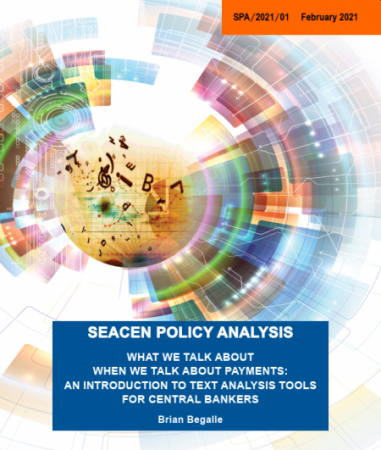
This issue, “What We Talk About When We Talk About Payments: An Introduction to Text Analysis Tools for Central Bankers”, is authored by Brian Begalle. It explains some of the emerging technology tools that can be used to analyze text and applies them to a series of speeches by central bankers. The paper seeks to…